
Why I Switched to Olympus—and Never Looked Back

Updated: Dec 19, 2025
Why I Switched From Canon to Olympus in 2020: A Lighter, Smarter Way to Tell Stories

For most of my career, Canon cameras were my constant companions. From racetracks to wildlife trails to everyday assignments, they helped me capture thousands of moments that built the foundation of my archive. But in 2020, after decades of carrying heavy DSLR bodies and lenses across the country, I found myself rethinking the tools I relied on. I needed something lighter, faster, and better suited to the way I tell stories today.
Olympus (Now know as OM System) had sponsored the Media Photo Room at Daytona International Speedway for Daytona Speedweeks in 2019, and part of their deal allowed them to set up a camera-loan operation at the speedway. For a while I'd watched with curiosity as photographers showed up at race track with smaller, lighter, mirrorless cameras and this seemed like an opportunity to try one out. The deal allowed photographers to borrow a camera body and two lenses for a couple of months with the option to purchase any equipment they wanted at a 50 per cent discount after the loaner period.
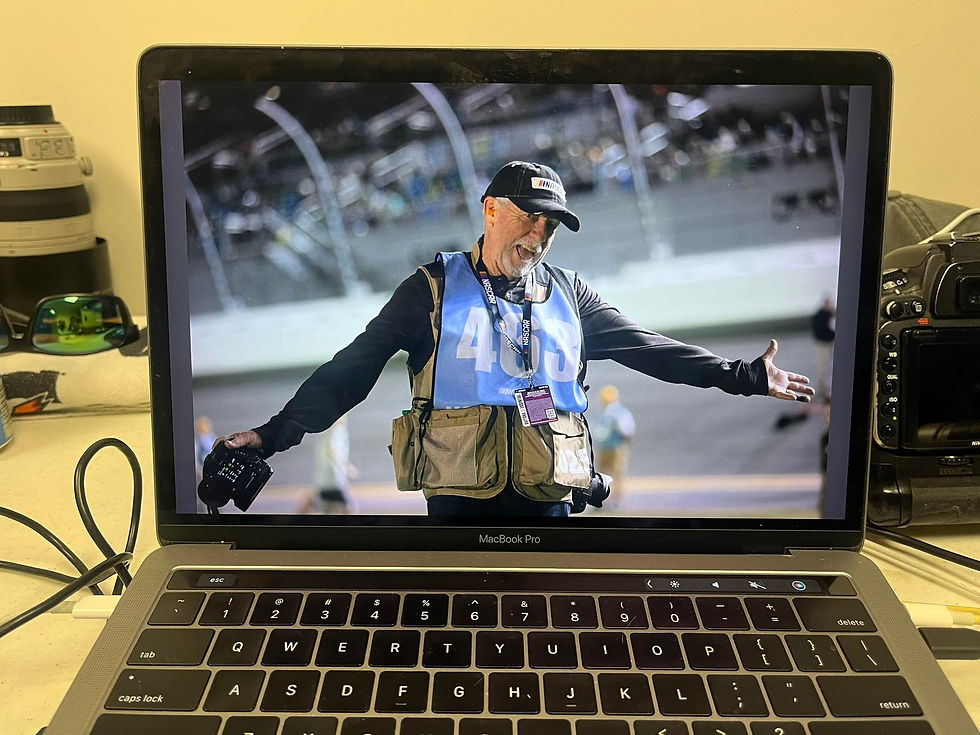
After trying out the camera and lenses for a couple of months, I made a sizable equipment purchase, with the intention of using the OM System gear as a second camera behind my Canon stuff.
It was not long, though, before I was stung by the mirrorless bug and blown away by some of the OM System features. I even took to calling the new camera my "magic camera"! That, coupled with the difficulty of having 2 different camera brands hanging from my shoulders, made me do a deep-think on whether I really wanted to make the switch.
I had done side-by-side image comparisons between the OM System and Canon files, had delivered a large number of images to clients and media outlets, and could find no reason to hold back. My Canon gear was reaching the age where it needed replacing and after experiencing the wonders of mirrorless cameras, I knew I would have to make a major investment in new Canon gear even if I wanted to remain a Canon shooter.
There were a few OM System feature that I was really drawn to, the Pro-Capture option in particular, so I decided it was time to go OM System, and once I made the switch, there was no turning back.

The Moment I Knew It Was Time for a Change
By 2020, mirrorless technology had advanced far enough to make me question the old DSLR mindset. The demands of my work—covering motorsports, wildlife, and high-action situations—required speed, agility, and long days on my feet. Lugging large bodies and big lenses to every assignment wasn’t just exhausting; it was limiting.
I wanted to stay nimble. I wanted tools that worked with me, not against me. And I realized I needed a system that reflected where photography was headed—not where it had been.
Why OM System Stood Out
1. Smaller Size, Bigger Freedom
The first thing that grabbed me was the size. OM System bodies and lenses are dramatically smaller and lighter than what I’d been carrying for years. That alone made an immediate impact.
Suddenly, I was hiking trails longer, moving faster along pit road, and shooting overhead angles I wouldn’t have attempted with heavier gear. The freedom that comes with shedding pounds from your kit is hard to describe until you feel it.

I loved the articulated viewing screen on the camera that allowed high and low angle shooting with resorting to "Hail Mary" shooting where you are not rally able to properly frame the image.
My Pelican case that I used to transport equipment in the airline overheads could hold much more OM System gear than Canon gear.
The compact size didn’t make me compromise on quality—it made me more creative.

2. Mirrorless Done Right
OM System's mirrorless system instantly felt modern, intuitive, and built for action. The electronic viewfinder let me preview exposure and color in real time. The autofocus was fast and accurate. And silent shooting opened up new possibilities for wildlife and behind-the-scenes work where shutter noise would be a distraction.
My "fly-on-the-wall" approach to photography in garages, press-conferences and banquet rooms benefitted greatly from the totally silent electronic shutter release.
For someone who photographs everything from racing at 200 mph to quiet moments in nature, mirrorless just made sense.
3. Amazing Features That Elevated My Work
OM System didn’t just offer a smaller camera—they packed it with features that genuinely changed how I work.
Pro Capture: Being able to capture frames before I press the shutter transformed how I shoot motorsports and wildlife behavior. Two teal life examples of my use of this feature are race car checkered flags, where it used to be a hit-or-miss proposition to get the winning car's nose on the finish line, pro-capture allows me to get the shot ever time. Secondly, for years I tried to get the exact moment of take-off when photographing birds taking flight but was never able to anticipate and execute the shot. Again, Pro-Capture allows me to get it every time.

IBIS (In-Body Image Stabilization): Handholding shots at slower shutter speeds became a reality. It felt like cheating.
Weather Sealing: Rain, dust, heat—Olympus bodies are tanks in disguise.
High-Speed Burst Rates: Perfect for peak action, whether on the track or in the field. The OM1 s I'm currently using allow me to shoot continuously in full RAW mode with tracking autofocus at up to 50 frames per second. In Pro-Capture I can shoot a one second pre-focused burst at 120 frames per second!
Live ND / Live Composite: Tools that expanded my creativity, letting me experiment without extra gear.
The last last laps and victory lane of the 2024 NASCAR Xfinity race at Daytona photographed at 50 frames per second and put together into a video. All photos by Brian Cleary/bcpix.com with OM System OM1.
These weren’t gimmicks—they were genuinely useful features that helped me capture better images with less effort.
Magic cameras!

4. A Smart Price Point
Another big reason for the switch was simple: value. OM System offered a professional-level system at a price point far more reasonable than other mirrorless options. It made upgrading bodies and adding lenses attainable without sacrificing performance.
I'm guessing the use of old-fashioned camera dials as opposed to information-heavy LCD displays are the types of things that might help to keep the s=cost down. This works for my, as I tend to be somewhat old-school when i t comes to camera controls.
For a working photographer, value isn’t just about cost—it’s about reliability, consistency, and longevity. OM System delivered all of it.

The Results: A Better, More Agile Photographer
Switching to OM System brought noticeable improvements to my shooting life. I found myself taking more risks, experimenting more often, and shooting longer without fatigue. My workflow tightened up. My travel load lightened. And I had a renewed energy for telling stories with my camera.
The gear didn’t just support my work—it inspired it.
Looking Back: No Regrets
After several years and countless assignments, I can say confidently that switching to OM System was one of the best decisions I’ve made in my career. The system continues to perform at a high level in demanding conditions, from racetracks to rocky trails to snowy Colorado mornings.
It gave me the tools I needed to grow, adapt, and stay excited about photography.
Final Thoughts
If you’re considering a switch of your own, don’t focus solely on megapixels or specs. Think about how the gear makes you feel, how it helps you move, and whether it supports the way you want to tell stories.
For me, OM System checked every box: lighter, smarter, feature-rich, and professional. It brought back the joy of simply going out and shooting.
You can explore more of my camera stories, as well as decades of motorsports, wildlife, and documentary photography, at BCPIX.com.

If you'd like more information and purchase options on some of the OM System gear I use, please click on the Amazon links below


Great perspective on the switch to Olympus! For tricky lighting, a photo shadow remover can also be a handy addition to the editing workflow.