
From 36 Frames to 50 FPS: A Film Shooter’s Perspective on Modern Photography

Updated: Jan 2
My photography career began around 1980, working as a stringer for wire services like The Associated Press and United Press International, obviously shooting 35mm film. Most of my assignments included coverage of sports events, along with occasional news and special assignments.

While I’ve never been one to glamorize the old days or go on about how much more difficult photography was in the era of film, I do feel there were some challenges we faced back then that today’s young shooters can tend to take for granted.
With that in mind, here are a few of the issues film shooters faced that have faded or disappeared since the advent of digital photography a quarter century
ago.

• Film management
In the days of film, from a film shooter's perspective, you had to be constantly aware of where you were on your roll. It was always a good idea to switch out your film whenever you got down to the last 10 frames. There was no more helpless feeling than hearing the whirring sound of your film being rewound while the photograph of the century presented itself in front of your now-filmless camera.
I was shooting on pit road during the 1984 NASCAR Busch Clash at Daytona and was down to the last six frames on my roll when Ricky Rudd’s Ford Thunderbird came tumbling wildly into sight. I was able to get six frames of one of the more infamous NASCAR crashes of the era before reaching the end of my roll, but to this day I wonder what my take might have looked like had I saved more frames on that roll.
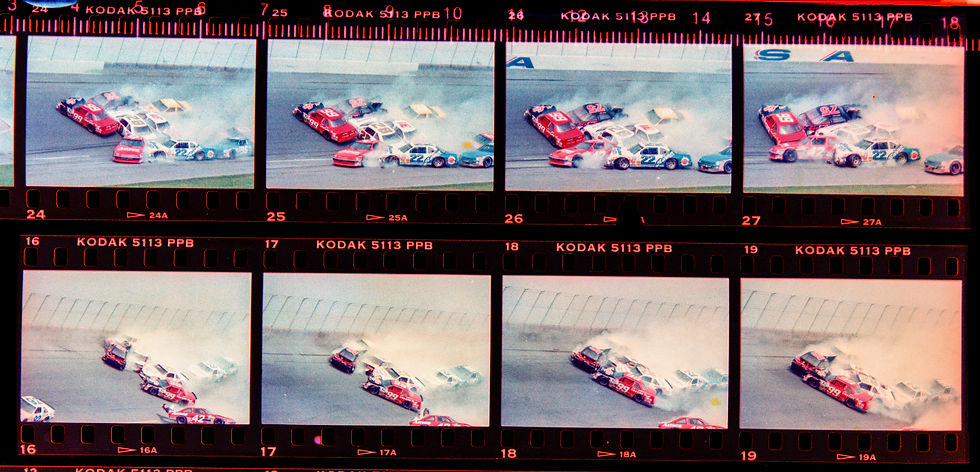
In contrast, a few years later, when a huge crash involved much of the field near the start of the 1990 NASCAR Busch Series race at Daytona, I was able to capture more than 30 frames of the action because I had a fresh roll of film loaded.

Fast-forward to February of this year, once again standing on pit road at Daytona for the NASCAR Xfinity Series race and shooting with a mirrorless OM System OM-1 at 50 frames per second, I captured more than 100 frames of a huge late-race accident. That would have burned through three full rolls of 35mm film back in the day — something that would have literally seemed like science fiction to the 25-year-old, film-shooting version of me.
• Manual focus
I still remember continuously rolling the focus ring of my lens between my thumb and forefinger, convincing myself I was focus-locked on my subject — a lost art for sure. I was pretty late to the autofocus party when the feature became available on cameras in the 1990s, and when reviewing my film archive today, I’m still pretty impressed with my ability at the time to keep subjects relatively sharp.

While I held onto the belief that my focusing talent was superior to in-camera autofocus for far too long, I eventually came to the realization that the technology had far outpaced my own ability.
Today’s cameras can not only lock subjects firmly in focus, but many modern models can even differentiate between race cars, birds, faces, and more.
• Exposure
A photographer shooting film back in the 1980s and 1990s had to rely on several methods to ensure proper exposure. Besides the old “f/8 and be there” rule of photojournalism, photographers could use their in-camera light meters, which were generally close but not infallible. This often required evaluating lighting conditions, shadows, highlights, and contrast to make a final exposure decision.

Another option was a handheld meter, which could be inconvenient to carry and use and still required interpretation of the scene.
In certain circumstances, a photographer could even shoot a Polaroid of the scene and use it to guide exposure settings. But because Polaroid emulsions varied significantly from roll or sheet film emulsions, even this method was not foolproof.
Another variable in the exposure equation was how the film was processed after it was shot. Slight variations in temperature and chemistry could result in noticeable differences in the final image. The hand-dunk tanks used at many remote, on-site shooting locations were notorious for their unpredictable conditions, often resulting in chemical crossover curves and other creative experiments in what could go wrong during film development.
In contrast, a quick review of images on the back of today’s digital cameras lets photographers immediately know how accurate their exposures are and what adjustments need to be made in-camera or in post-production.
These are just a few of the things yesterday’s photographers had to consider while shooting their assignments. So yes, while photography is still photography — and a great photo is still a great photo — the challenges of shooting film required a very different approach than creating digital images today.
Photo Stories at BCPIX.com
Original photography and firsthand visual history by Brian Cleary.
All images © Brian Cleary. Editorial licensing available.
Some posts may include sponsored or affiliate links.


This is a fascinating perspective on the evolution of film shooting and modern photography. The connection between traditional frames and new visual technologies shows how storytelling continues to change. For photographers and filmmakers, converting video footage into editable slides can be a useful way to present creative ideas and technical insights.
Our 3rd grade class did a Christmas party and I pulled 25 Christmas bingo boards on Friday afternoon during prep.
Kids loved that the icons were actually varied instead of the same snowman repeated on every card like that other free site does.