
High Stakes, Slow Shutter: Life in Car-to-Car Racing Photography

It’s January, and for sports car racing photographers working in the United States, that can only mean one thing: it’s time to head south for the annual pre-season ROAR before the 24, a test session for teams competing in the world-famous 24-hour endurance race.

Not only do race teams use this session to prepare their machines for the grueling twice-around-the-clock event, this is also the time for teams’ content creators to capture imagery heading into the new year. Liveries, sponsors, firesuits, and driver lineups have all been updated, making this one of the most important content opportunities of the season.
One of the most highly desired sets of fresh content involves spectacular rolling car-to-car photo shoots, where photo vehicles lead race cars slowly around the speedway while photographers and videographers capture imagery that, when done right, creates the illusion that the cars are traveling at race speeds—often in iconic venues.

Over the course of my career pointing cameras at race cars, I’ve been lucky enough to create car-to-car photography featuring some of the most spectacular machinery ever to roll around America’s race tracks.
Although the images from these shoots are usually spectacular, the lead-up and stress involved in the process can take a toll on everyone involved.
The first thing a photographer should keep in mind is that while the content produced is important to teams, manufacturers, and series, the primary reason the cars are at the event is to be ready to race once the green flag falls—not to be on call for a photo shoot. A healthy dose of humility and flexibility is required to accomplish the shoot without rubbing too many people the wrong way. An overbearing approach can easily do long-term damage to a photographer’s reputation, branding them as demanding and difficult to work with.
There are always limited time slots available, with the best light—early morning and late afternoon—being the most in demand. The photographer must coordinate with the track, series, and team to ensure their desires align with the realities presented by each of these entities.

If I’m fortunate enough to secure one of these time slots, I always evaluate the sky, clouds, sun angle, and overall conditions, and I make sure to shoot enough low angles to include them in the frame.
Here are a few of my personal preferences when it comes to car-to-car photography.
PHOTO VEHICLE SPEED:I prefer to roll at about 35–60 miles per hour. There is really no need to go faster, and higher speeds usually result in fewer usable images due to bumps in the track surface and the photographer being thrown off balance in turns.

RACE CAR POSITIONING:I like the race cars to be nice and close to the photo vehicle. This elongates the nose of the car and emphasizes motion in the texture of the track surface. If the car gets too close for the lens being used, a simple hand signal can get the driver to back off slightly. If the car falls too far behind, the photos become, to me, quite boring and start to resemble images taken by a trackside photographer.
LENS FOCAL LENGTH:I prefer to use a lens in the 12mm to 20mm range. As mentioned above, this gives the long, sleek appearance I’m looking for in a race car. It also allows for more track surface in the frame to show movement and suggested speed. Finally, a wider lens lets me include more background and sky, enhancing the sense of venue, sunrise, sunset, clouds, and atmosphere.
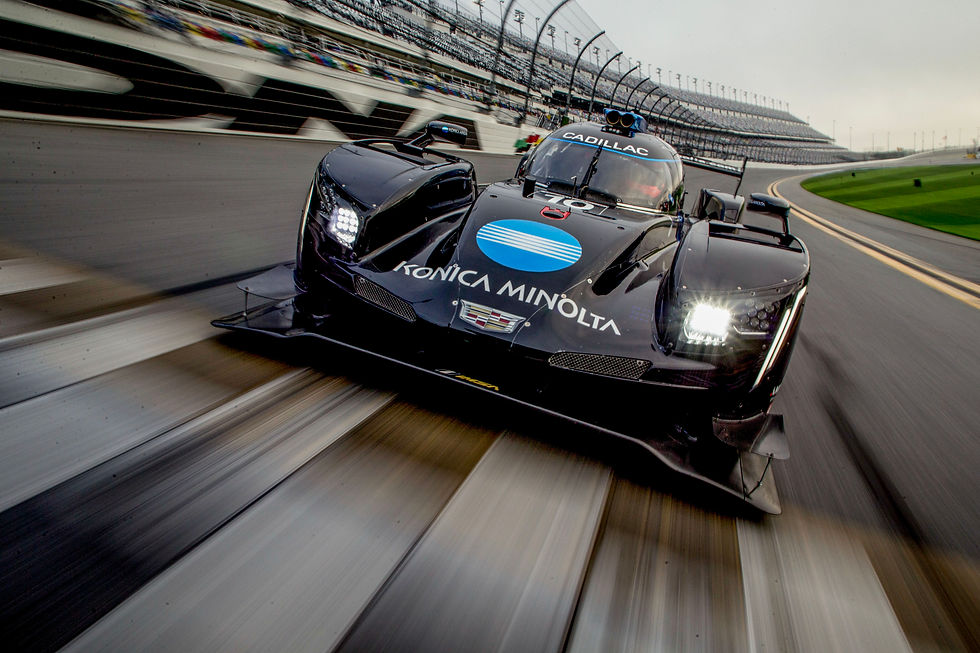
SHUTTER SPEED:Years of experience have shown me that, for the look I prefer, a shutter speed between 1/20th and 1/60th of a second is required. The dramatic feel of rolling images disappears quickly as shutter speed increases. On the other end of the spectrum, going slower than 1/20th of a second greatly reduces the percentage of sharp images.
COMMUNICATION:While there is often a radio-equipped team member along on the shoot, I prefer direct hand signals between the photographer and the driver. It’s easy to establish a basic set of signals, and this cuts down on the time required to communicate. That said, it’s always beneficial to have a brief meeting with the drivers of both the race cars and the photo vehicle beforehand to outline the plan and expectations. The radio-equipped team member remains important for relaying information that wasn’t discussed in advance.

MISCELLANEOUS:Shoot as many frames as possible. Slow shutter speeds will result in a high number of rejected images. Always be aware of your position on the track, as certain locations may be prioritized—such as a finish line or an iconic structure. Secure all of your equipment, and of course yourself, inside the photo vehicle. A camera or lens embedded in the grille of a million-dollar race car is a sure way to end your career as a car-to-car photographer.
These shoots typically happen on a tight schedule, so experience has taught me that everything must be ready to go the moment you’re released from pit road. Any delay can cut into your track time or even remove you from the rotation altogether. When you’re not prepared, you’re not only wasting your own time—you’re wasting the team’s time, the track’s time, the series’ time, and the time of everyone lined up behind you.

These photo shoots are among the most anticipated of the year and provide an enormous amount of valuable content for teams, manufacturers, tracks, and series.
I’ve always found these assignments to be high in stress as the moment approaches, but long in satisfaction once the images have been captured.
delivered.
Photo Stories at BCPIX.com
Original photography and firsthand visual history by Brian Cleary.
All images © Brian Cleary. Editorial licensing available.
Some posts may include sponsored or affiliate links.


Comments