top of page

From a Gap in the Fence to a Life in Motorsports

It was 60 years ago this year that the 8-year-old me stuck a cheap plastic camera through a gap in the fence under the flagstand at Daytona International Speedway and snapped a photo of Ken Miles and Lloyd Ruby sitting next to their Ford GT40 celebrating their victory in the 24 Hours of Daytona.


The #98 Ford GT40 of Ken Miles and Lloyd Ruby is shown in victory lane after winning the 1966 24 Hours of Daytona at Daytona International Speedway in Daytona Beach, Florida. (Photo by Brian Cleary/bcpix.com)

Since about 1980 I've been photographing race cars as a credentialed photographer but, like many of us, the roots to my life in motorsports run much deeper.


In the mid-1960s, my father was working for General Electric in Massachusetts when the company was awarded contracts to work on NASA's Apollo program after President Kennedy announced America's intention of flying to the moon.


As a result of this new direction, my dad was transferred by General Electric to their offices in Daytona Beach, Florida, directly across Volusia Avenue from the 5-year-old Daytona International Speedway.


My dad, a World War II veteran with an interest in both photography and auto racing, excitedly welcomed the transfer to Florida and moved down there in ahead of his family in 1964. Of course, he immediately went to the speedway for that summer's NASCAR Firecracker 400. I still have a copy of a letter he sent back to us describing the experience as well as an impressive young driver named Dick Perry. This was my father's misspelled version of Richard Petty's name.


We joined him in Daytona in early 1965 and I immediately became my fathers racetrack buddy, going with him to the track for every event that came along.


The #16 Porsche 904 GTS 005 of Gerhard Mitter and Joe Buzzetta is shown in the winners circle after its 7th place podium finish in the 1966 24 Hours of Daytona at Daytona International Speedway, Daytona Beach, Florida, February 6, 1966. (Photo by Brian Cleary/bcpix.com

By 1966, the first year Daytona's annual sports car race was expanded to a full 24 hour endurance event, I had been to the track a handful of times, and was already a fully committed fan of the NASCAR drivers and races, as was my dad, but we always went to the winter sports car events as a way to prime us for the upcoming Daytona 500.


What I remember about that race was how large the field was. 60 cars took the green flag for that event compared to the roughly 40 cars that traditionally start a typical NASCAR race. The diversity of the cars also stood out with Prototype cars racing alongside GT cars and Touring cars. Essentially races within races.


Besides the Ford GTs, I loved the Cobras of that era and I can vividly remember spending many days in third grade art class drawing my interpretations of the Cobra Coupes with their chopped-off rear ends.


Besides my NASCAR heroes of the time like Fred Lorenzen, Richard Petty, Cale Yarborough (my dad's favorite) and Buddy Baker, Ken Miles really made an impression on me for some reason. I remember reading of his death in a testing crash shortly after his Daytona win and how sad it made me feel.
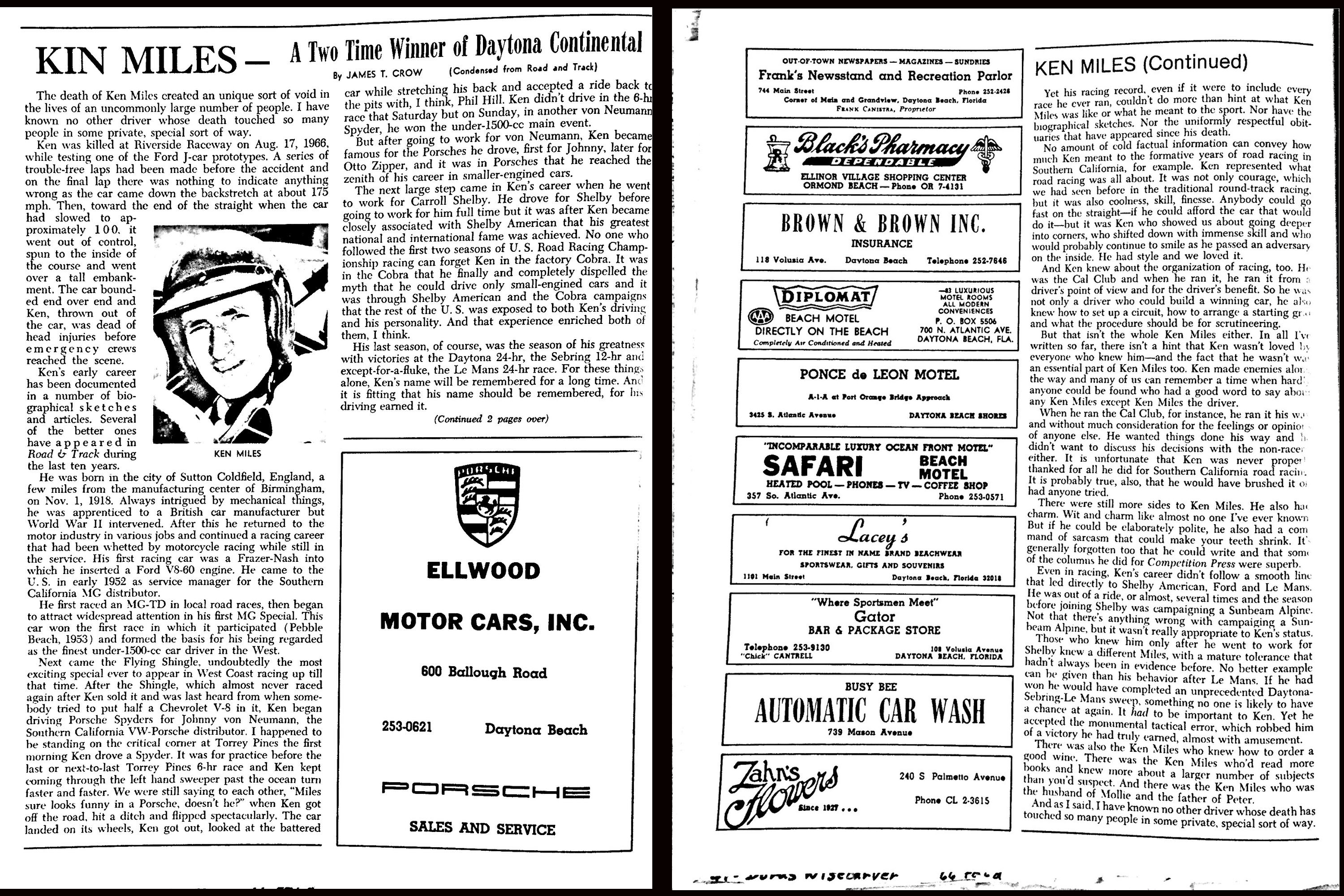

An article about the death of race car driver Ken Miles in August of 1966, including the unfortunate misspelling of his name in the headline.

Decades later, when the movie "Ford vs. Ferrari" came out many of these memories came flooding back. I've mentioned to several people how the film's dramatization of the 1966 24 Hours of Daytona, which was filmed at California Speedway did not align with my memory of the race.


In contrast to the bright, polished, colorful venue that is California Speedway, my recollection of Daytona at the time is one of a dark, grey, echoey, cavernous structure made magical by the addition of cool cars and heroic drivers.


So, you throw a mixture of NASA contracts, corporate transfers, an evolving American sports car scene and a kid with a cheap camera into a pot and stir. 60 years later I find myself looking back on an amazing career photographing motorsports as I sit over my laptop and type out blog entries.


Thanks Dad!


Photo Stories at BCPIX.com

Original photography and firsthand visual history by Brian Cleary.

All images © Brian Cleary. Editorial licensing available.

Some posts may include sponsored or affiliate links.


Comments


Photo Stories by BCPIX


Photo Stories is the narrative side of BCPIX.com—a place where photography, history, and storytelling intersect. Drawing from my extensive film and digital archives, each post explores the stories behind the images: the people, places, and moments that define a particular time and experience.


While BCPIX is widely recognized for its motorsports photography—including NASCAR, IndyCar, and sports car racing—Photo Stories also showcase other sports photography, documentary photojournalism, wildlife, and landscape imagery. Together, these collections reflect a broad visual record, ranging from high-speed competition and behind-the-scenes access to quiet, observational moments in nature and everyday life.


All imagery on BCPIX.com is created from firsthand experience and original photography, with an emphasis on authenticity, historical context, and editorial integrity.


For Photo Buyers, Publishers & Editors


BCPIX.com welcomes inquiries from photo editors, publishers, researchers, authors, and content producers seeking high-quality, historically significant imagery. The archive contains professionally shot photographs suitable for editorial use in magazines, books, newspapers, documentaries, educational materials, and digital media.


Many images on BCPIX.com may be licensed directly through the site, providing a streamlined, rights-managed licensing process. In certain cases, commercial licensing may also be available. Buyers and editors are encouraged to explore the archive and contact BCPIX.com with specific usage requirements or custom requests.


Copyright & Licensing Notice


All photographs published on BCPIX.com are © Brian Cleary and are protected by U.S. and international copyright laws.


Images may not be copied, reproduced, republished, transmitted, or otherwise used without prior written permission. Unauthorized use is prohibited. Licensing is available for approved uses, either directly through the site or by arrangement.


Sponsored Content Disclosure


Some posts on BCPIX.com may include sponsored or affiliate links to related products, books, prints, or equipment. These links help support the ongoing preservation, digitization, and presentation of the BCPIX photographic archive. Sponsored links do not influence the editorial independence, historical accuracy, or opinions expressed within Photo Stories.

© 2024 by Brian Cleary/bcpix.com Powered and secured by Wix

bottom of page